
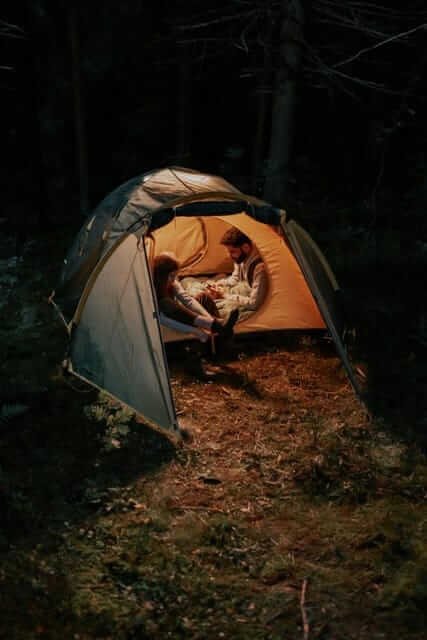
Why Cornwall is great for stargazing: away from the towns, much of Cornwall has very little light pollution, and Bodmin Moor was named an International Dark Sky Landscape in 2017. At Perran Springs we keep park lighting to the main amenity area to protect the night sky, so on a clear night you can see a sky full of stars from your pitch. Mid-August is especially good, as it’s the peak of the Perseid meteor shower.
One of the simple pleasures of camping is lying back on a clear night and looking up. You don’t need a telescope or any knowledge to enjoy it. Here’s a beginner’s guide.
When to look
- Clear nights: check the forecast for cloud cover. Clear, still nights after a front has passed often give the sharpest skies.
- Around the new moon: a bright moon washes out faint stars, so the few days either side of a new moon are best.
- Late evening: in summer it doesn’t get properly dark until late, so be patient.
- Late August and early September: darker evenings arrive earlier, so you don’t have to stay up so late.
Let your eyes adjust
It takes around 20 minutes for your eyes to adapt to the dark. Avoid looking at your phone screen, or turn it to night mode and dim it right down. A red-light torch is ideal, as it doesn’t ruin your night vision. Many head torches have a red setting.
What to look for
The Plough and the North Star
The Plough, part of the constellation Ursa Major, is easy to find: seven bright stars shaped like a saucepan. Follow the two stars at the end of the “pan” upwards and you’ll reach Polaris, the North Star.
The Milky Way
On a dark, clear night in late summer, look for a faint, cloudy band stretching across the sky. That’s our own galaxy, seen edge on. It’s one of the most memorable things to show children.
The Summer Triangle
Three bright stars, Vega, Deneb and Altair, form a large triangle high overhead on summer evenings. Once you’ve spotted it, you’ll find it every night.
Planets
Planets look like bright stars that don’t twinkle. Free stargazing apps will tell you which ones are visible during your stay.
Satellites and the ISS
You’ll often see satellites gliding steadily across the sky. The International Space Station is very bright and moves quickly. Apps and websites can tell you when it’ll pass over Cornwall.
The Perseid meteor shower
Each August, Earth passes through debris from a comet, creating the Perseids. The shower peaks around 12 and 13 August, but you can see meteors for several nights either side. On a dark, clear night you might see dozens per hour. Just lie back, look up and be patient.
Stargazing kit
- A blanket or reclining camping chair
- Warm layers and a hot drink. It gets chilly even in summer
- A red-light torch
- A stargazing app
- Binoculars, if you have them, for the moon and star clusters
Be considerate
Keep voices low and torches pointed down. Other campers may be asleep, and bright lights spoil everyone’s view.
Frequently asked questions
Is Cornwall good for stargazing?
Yes. Many rural parts of Cornwall have low light pollution, and Bodmin Moor was designated an International Dark Sky Landscape in 2017.
When is the best time to see the Perseids?
The Perseid meteor shower peaks around 12 and 13 August each year, with meteors visible for several nights either side on clear nights.
Is Perran Springs a good place to see the stars?
Yes. We keep lighting to the main amenity area to reduce light pollution, so on clear nights the sky over the park is wonderfully dark.
Swap streetlights for starlight. Book a camping pitch in the Cornish countryside, and don’t forget your torch. You can also read about the wildlife on the park on our nature page.