
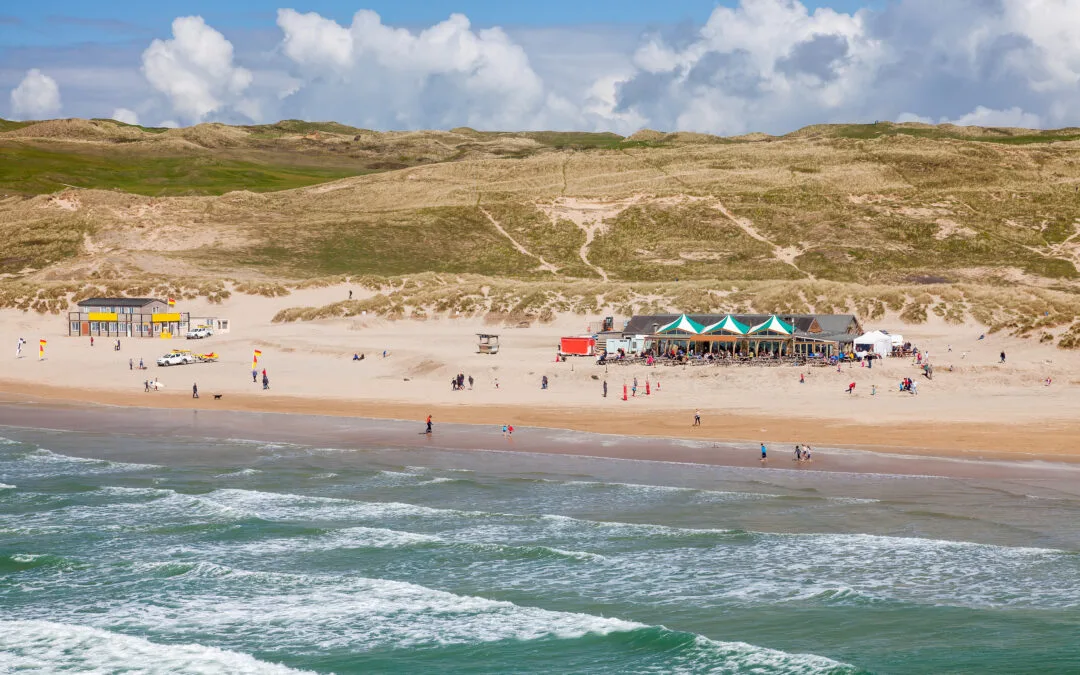
The essentials: St Piran is the patron saint of Cornwall and of tin miners, and his feast day is 5 March. Legend says he landed at Perran Sands near Perranporth, and the remains of St Piran’s Oratory, a later medieval church and an early stone cross still sit in the dunes there. You can walk to them across the sands from Perranporth, which is about two and a half miles from Perran Springs.
With St Piran’s Day coming up, we thought we’d share the story of the saint who gave Perranporth its name, and how to find the places linked to him.
Who was St Piran?
Piran is thought to have been an Irish monk who lived around the 5th or 6th century. The most famous legend says he was tied to a millstone and thrown into the sea by Irish kings, but instead of sinking, the stone floated and carried him across the water to the sandy beach we now call Perran Sands. He built a small hermitage there, and his first followers were said to be a badger, a fox and a bear.
Another story credits him with discovering tin. When his black hearthstone grew hot, a stream of white tin ran out of it, forming a white cross on a black background. That’s the design of the Cornish flag, St Piran’s Flag, which you’ll see flying all over the county.
What is Perranzabuloe?
Our local parish is called Perranzabuloe, which comes from Latin and roughly means “Piran in the sand”. It’s a fitting name. Over the centuries, the shifting dunes repeatedly buried the buildings connected with the saint, which is why the area’s history is a story of things lost and found.
St Piran’s Oratory
The oratory is a small early medieval chapel in the dunes behind Perranporth beach, traditionally said to stand where Piran founded his cell. It was swallowed by the sand, uncovered in the 19th century, then deliberately reburied in 1980 to protect it. In 2014 it was excavated again by the St Piran Trust and local volunteers, and you can now see its low stone walls in the dunes.
St Piran’s Church and Cross
A short walk inland are the remains of St Piran’s Old Church, built after the oratory was lost to the sand, and later abandoned too as the dunes advanced. Nearby stands St Piran’s Cross, an early granite cross that has been a landmark in the dunes for many centuries. It’s an atmospheric spot, especially on a quiet, windy day.
Walking to the oratory
From Perranporth, head north along the beach towards the dunes at Penhale. Paths lead up into the sands, and the sites are signposted, though the dunes can be confusing, so a map or walking app helps. Allow a couple of hours there and back at a gentle pace, and wear decent shoes, as walking in soft sand is harder work than it looks.
Part of the dunes is a protected nature site and part is used by the Ministry of Defence, so stick to the marked paths and obey any signs. It’s a lovely walk for dogs too, kept under control around grazing animals and nesting birds.
St Piran’s Day
On or around 5 March each year, Cornwall celebrates its patron saint with black and gold flags, Cornish music and events across the county. In Perranporth, people traditionally gather to walk across the dunes to St Piran’s Cross, and there’s often a play retelling the saint’s story on the sands.
For more on the area’s past, read our post on the history of Perranporth.
Frequently asked questions
When is St Piran’s Day?
St Piran’s Day is 5 March each year and is Cornwall’s national day.
Where is St Piran’s Oratory?
The oratory lies in the dunes of Penhale Sands, north of Perranporth beach. It can be reached on foot across the beach and dunes from Perranporth.
Why is the Cornish flag black and white?
Legend says St Piran discovered tin when white metal flowed from his black hearthstone, forming a white cross on black. This became St Piran’s Flag, the flag of Cornwall.
Perranporth and its dunes are just down the road from us. Find out more about Perranporth camping or book your stay.